Study notes
Explore function notation, domain and range, composite functions, inverse functions, and transformations. Each section includes a worked example and a key idea.
1. Function Notation, Domain and Range
A function is a rule that assigns exactly one output to each input in its domain. We often write a function as f(x).
WORKED EXAMPLE 1 · Function notation
Given f(x) = x2 − 3x + 2, find f(4).
f(4) = 42 − 3(4) + 2
= 16 − 12 + 2
= 6
To find f(a), replace every x with a:
f(a) = a2 − 3a + 2.
Your turn · 4 questions
Try these questions before checking your answers.
Timer is unavailable in this view.
- Given f(x) = x2 − 4x + 7, find f(3).
- Given g(x) = 2x2 − 3x + 5, find and simplify g(a − 1).
- Given f(x) = 3x2 − 2x + 1, find f(−2).
- Given h(x) = x2 + 2x − 3, find and simplify h(t + 1).
Show answers and working
1. Substitute 3 for every x:
f(3) = 32 − 4(3) + 7
= 9 − 12 + 7
= 4.
2. Substitute a − 1 for every x:
g(a − 1) = 2(a − 1)2 − 3(a − 1) + 5
= 2(a2 − 2a + 1) − 3a + 3 + 5
= 2a2 − 4a + 2 − 3a + 3 + 5
= 2a2 − 7a + 10.
3. Substitute −2 for every x:
f(−2) = 3(−2)2 − 2(−2) + 1
= 3(4) + 4 + 1
= 17.
4. Substitute t + 1 for every x:
h(t + 1) = (t + 1)2 + 2(t + 1) − 3
= t2 + 2t + 1 + 2t + 2 − 3
= t2 + 4t.
The domain is the set of allowed input values. The range is the set of output values produced by those inputs.
General method · quadratic range
1. Complete the square to find the turning point.
2. Check whether its x-value is in the given domain.
3. On a closed interval, calculate the values at both endpoints as well.
4. Compare the allowed values to find the minimum and maximum. Remember: an excluded endpoint is not itself attained.
General method · completing the square
1. If the coefficient of x2 is not 1, factor it out of the quadratic and linear terms first.
2. Halve the coefficient of x inside the bracket. Put x and that signed value together in a bracket, then square it.
3. Subtract its square to keep the expression unchanged, then simplify the constant.
Check by expanding your final expression.
WORKED EXAMPLE 2A · Range of a quadratic function
Given f(x) = x2 − 6x + 11, for −1 ≤ x ≤ 5, find its domain and range.
Step 1: State the domain.
The given domain is −1 ≤ x ≤ 5.
Step 2: Complete the square.
Half of −6 is −3. Squaring gives 9, so subtract 9 to keep the expression unchanged.
f(x) = x2 − 6x + 11
= (x − 3)2 − 9 + 11
= (x − 3)2 + 2.
The turning point is (3, 2). The graph opens upwards, so it is a minimum point. Since x = 3 lies within the given domain, the minimum value is 2.
Step 3: Check the endpoints.
f(−1) = (−1 − 3)2 + 2 = 16 + 2 = 18
f(5) = (5 − 3)2 + 2 = 4 + 2 = 6
The parabola opens upwards, so its maximum on this closed interval is at an endpoint. The larger endpoint value is 18.
Range: 2 ≤ f(x) ≤ 18.
Your turn · 4 questions
Try these questions before checking your answers.
Timer is unavailable in this view.
- For −1 ≤ x ≤ 4, let h(x) = x2 − 4x + 7. Complete the square and find its range.
- For 0 ≤ x ≤ 3, let k(x) = −x2 + 4x + 1. Complete the square and find its range.
- For −3 ≤ x ≤ 2, let f(x) = x2 + 2x − 8. Complete the square and find the range.
- Challenge: For 4 ≤ x ≤ 6, let f(x) = −x2 + 6x − 5. Complete the square and find the range.
Show answers and working
1. Complete the square:
h(x) = x2 − 4x + 7
= (x − 2)2 − 4 + 7
= (x − 2)2 + 3.
The turning point is at x = 2, inside the domain, so the minimum is 3. Check both endpoints:
h(−1) = (−3)2 + 3 = 12
h(4) = 22 + 3 = 7.
The maximum is 12, so 3 ≤ h(x) ≤ 12.
Visual check: The solid curve shows only the given domain. T is the minimum; compare the two solid endpoints for the maximum.
A: (−1, 12); turning point T: (2, 3); B: (4, 7).
2. Factor out the negative sign first, then complete the square:
k(x) = −(x2 − 4x) + 1
= −[(x − 2)2 − 4] + 1
= −(x − 2)2 + 5.
The turning point is at x = 2, inside the domain, so the maximum is 5. Check both endpoints:
k(0) = −(−2)2 + 5 = 1
k(3) = −12 + 5 = 4.
The minimum is 1, so 1 ≤ k(x) ≤ 5.
Visual check: The turning point T gives the maximum; compare the solid endpoints for the minimum.
A: (0, 1); turning point T: (2, 5); B: (3, 4).
3. Complete the square:
f(x) = (x + 1)2 − 1 − 8
= (x + 1)2 − 9.
The turning point x = −1 is in the domain, so the minimum is −9.
Check both endpoints:
f(−3) = (−2)2 − 9 = −5
f(2) = 32 − 9 = 0.
The maximum is 0, so −9 ≤ f(x) ≤ 0.
4. Factor out −1 from the first two terms, then complete the square:
f(x) = −(x2 − 6x) − 5
= −[(x − 3)2 − 9] − 5
= −(x − 3)2 + 4.
The turning point is at x = 3, which is outside the domain. For 4 ≤ x ≤ 6, the graph decreases as x moves to the right. Check its endpoints:
f(4) = −1 + 4 = 3
f(6) = −9 + 4 = −5.
So −5 ≤ f(x) ≤ 3.
Visual check: T is outside the allowed domain. The dashed part is excluded, so use the solid curve from A to B.
A: (4, 3); turning point T: (3, 4), outside the domain; B: (6, −5).
General method · fraction domain and range
1. Find the domain: exclude inputs that make a denominator zero.
2. Rewrite the expression as a constant plus a fraction, if possible, and consider which outputs it can take.
3. Check whether any stated domain restriction removes further outputs. An asymptote can help, but check whether its value is actually excluded.
WORKED EXAMPLE 2B · Domain and range of a fraction
Find the domain and range of f(x) = , where x is real and the expression is defined.
Step 1: Find the domain.
The denominator cannot be zero:
x − 3 ≠ 0
x ≠ 3 (add 3 to both sides).
Therefore the domain is x ∈ ℝ, x ≠ 3.
Step 2: Rewrite the fraction.
We want the numerator to contain a multiple of the denominator. First, 2(x − 3) = 2x − 6. To change −6 into +1, add 7:
2x + 1 = 2(x − 3) + 7.
Substitute this into the fraction and split the numerator:
f(x) =
= + .
Because x ≠ 3, the common factor x − 3 is nonzero and can be cancelled:
f(x) = 2 + .
The fraction can never equal zero, so f(x) can never equal 2.
Step 3: Check that all other outputs are possible.
Let y = 2 + . Subtract 2 from both sides:
y − 2 = .
Multiply by x − 3, then divide by y − 2 (which is nonzero because y ≠ 2):
(y − 2)(x − 3) = 7
x − 3 =
x = 3 + .
This input is allowed because its difference from 3 is nonzero. Every real output except 2 is possible.
Range: f(x) ∈ ℝ, f(x) ≠ 2.
What if the domain is restricted to x > 3?
Then x − 3 is positive, so is positive. As x approaches 3 from the right, f(x) increases without bound; as x increases, f(x) approaches 2 from above. The range is f(x) > 2.
Your turn · 4 questions
Try these questions before checking your answers.
Timer is unavailable in this view.
- Let f(x) = , for all real x for which the expression is defined. State its domain and range.
- Using the same function, restrict the domain to x > −2. Find the new range.
- Let f(x) = for all real x for which the expression is defined. Find its domain and range.
- Let g(x) = 4 − for x > 2. Find the range of g.
Show answers and working
1. The denominator cannot be zero:
x + 2 ≠ 0
x ≠ −2 (subtract 2).
Rewrite the numerator: 3x − 1 = 3(x + 2) − 7.
Substitute into the original fraction, then split and cancel the common factor:
f(x) =
= 3 − .
The fraction is never zero, so f(x) ≠ 3.
To check the other outputs, let y = 3 − :
y − 3 = −
(y − 3)(x + 2) = −7
x + 2 = − (divide by y − 3)
x = −2 − .
For each y ≠ 3, this gives an allowed input. Domain: x ∈ ℝ, x ≠ −2. Range: f(x) ∈ ℝ, f(x) ≠ 3.
2. When x > −2, the denominator is positive, so f(x) < 3. The function approaches 3 from below and decreases without bound near −2. Range: f(x) < 3.
3. The denominator cannot be zero: x + 1 ≠ 0, so x ≠ −1.
Rewrite the numerator: 2x + 7 = 2(x + 1) + 5. Hence
f(x) = 2 + .
The fraction cannot be zero, so f(x) ≠ 2. To check all other outputs, let y = 2 + :
y − 2 =
x + 1 =
x = − 1.
For every y ≠ 2, this gives an allowed input. Thus the range is all real numbers except 2.
4. Because x > 2, the denominator x − 2 is positive. Therefore > 0 and g(x) < 4.
To check every output below 4 is possible, let y < 4 and rearrange:
4 − y =
x − 2 =
x = 2 + .
Since 4 − y > 0, this input satisfies x > 2. Thus the range is g(x) < 4.
Key idea: The range depends on the domain. For a quadratic, check that its turning point is in the domain and compare any included endpoints. For a fraction, exclude inputs that make the denominator zero and check which outputs are actually possible. An asymptote can be a clue, but its value is not automatically excluded for every function.
Common domain restrictions: a denominator cannot equal zero; for a real-valued square root, the expression under the square root must be non-negative.
Past paper connection: Try Paper 15, Question 9(b)(ii) to practise the domain and range of an inverse function.
2. Composite Functions
A composite function applies one function after another. The notation fg(x) means f(g(x)): apply g first, then apply f.
General method · composite functions
1. Read from the inside out: in fg(x) = f(g(x)), apply g first.
2. Substitute the whole result into f and simplify.
3. For gf(x), reverse the order. The two results are not usually equal.
WORKED EXAMPLE 3 · Finding composites
Given f(x) = 2x + 1 and g(x) = x2 − 3, find fg(x) and gf(x).
fg(x) = f(g(x))
= 2(x2 − 3) + 1
= 2x2 − 6 + 1
= 2x2 − 5.
gf(x) = g(f(x))
= (2x + 1)2 − 3
= 4x2 + 4x + 1 − 3
= 4x2 + 4x − 2.
Your turn · 4 questions
Try these questions before checking your answers.
Timer is unavailable in this view.
- Let f(x) = 2x − 1 and g(x) = x2 + 3, for real x. Find fg(x) and gf(x).
- Let f(x) = 2x + 1 and g(x) = x2, for real x. Solve fg(x) = 19.
- Let f(x) = x − 2 and g(x) = 3x + 1, for real x. Find fg(x) and gf(x).
- Let f(x) = x + 1 and g(x) = x2, for real x. Solve gf(x) = 16.
Show answers and working
1. Apply the inside function first:
fg(x) = 2(x2 + 3) − 1
= 2x2 + 6 − 1 = 2x2 + 5.
gf(x) = (2x − 1)2 + 3
= 4x2 − 4x + 1 + 3
= 4x2 − 4x + 4.
2. First find the composite: fg(x) = 2x2 + 1.
Now solve:
2x2 + 1 = 19
2x2 = 18 (subtract 1)
x2 = 9 (divide by 2)
x = ±3.
3. For fg, apply g first:
fg(x) = f(3x + 1) = 3x + 1 − 2 = 3x − 1.
For gf, apply f first:
gf(x) = g(x − 2) = 3(x − 2) + 1 = 3x − 5.
4. Apply f first, then g:
gf(x) = (x + 1)2.
Set the result equal to 16:
(x + 1)2 = 16
x + 1 = 4 or x + 1 = −4
x = 3 or x = −5.
For f(g(x)) to be defined at a particular input, x must be in the domain of g and the output g(x) must be in the domain of f. A composite is defined for every input in the domain of g when the range of g is a subset of the domain of f.
General method · composite domain
1. Check where the inside function is defined.
2. Find its output and check that it is allowed as the input of the outside function.
3. Combine both restrictions. For a square root, its expression must be ≥ 0; for a fraction, its denominator must be ≠ 0.
WORKED EXAMPLE 4 · Domain of a composite
Let f(x) = for x ≥ 0, and let g(x) = x − 4 for all real x. The largest domain for fg is found from:
fg(x) = . The expression inside a square root must be nonnegative:
x − 4 ≥ 0
x ≥ 4 (add 4 to both sides).
Your turn · 4 questions
Try these questions before checking your answers.
Timer is unavailable in this view.
- Let f(x) = for x ≥ 0 and g(x) = x − 5 for all real x. Find the domain of fg.
- Let f(x) = for x ≠ 2 and g(x) = x2 − 1 for all real x. Find the domain of fg.
- Let f(x) = for x ≥ −2, and g(x) = 3x − 5 for all real x. Find the domain of fg.
- Let f(x) = for x ≠ −1, and g(x) = x2 − 5 for all real x. Find the domain of fg.
Show answers and working
1. Substitute g(x) into f: fg(x) = .
The expression inside the square root must be nonnegative:
x − 5 ≥ 0
x ≥ 5 (add 5 to both sides).
2. Substitute g(x) = x2 − 1 into f:
fg(x) = = .
The denominator cannot be zero:
x2 − 3 ≠ 0
x2 ≠ 3 (add 3)
x ≠ ±.
So the domain is all real numbers except these two values.
3. Apply g first:
fg(x) = = .
The square-root expression must be nonnegative:
3x − 3 ≥ 0
3x ≥ 3
x ≥ 1.
4. Substitute the inside function into the denominator:
fg(x) =
= .
The denominator cannot be zero:
x2 − 4 ≠ 0
x2 ≠ 4
x ≠ −2 and x ≠ 2.
Key idea: Work from the inside out. In general, fg(x) ≠ gf(x).
Past paper example · May/June 2026 · Paper 11 · Question 9(b)
Composite functions and a parameter
Functions f and g are defined for all real x by f(x) = x − 3 and g(x) = x3 − 8a, where a is a positive constant.
It is given that gf(−1) + 20a2 = 0.
(b)(i) Find the value of a. [4]
(b)(ii) Find the set of values of k for which gf(x) = fg(x) + k has no real solutions. [5]
Show step-by-step solution
(b)(i) Find a. Work from the inside out:
f(−1) = −1 − 3 = −4
gf(−1) = g(−4) = (−4)3 − 8a = −64 − 8a.
Substitute into gf(−1) + 20a2 = 0:
−64 − 8a + 20a2 = 0
20a2 − 8a − 64 = 0
5a2 − 2a − 16 = 0 (divide every term by 4)
(5a + 8)(a − 2) = 0.
Set each factor equal to zero:
5a + 8 = 0 or a − 2 = 0
5a = −8 or a = 2
a = − or a = 2.
Since a is positive, a = 2. The other root, , is not allowed.
(b)(ii) Compare the composites. Substituting a = 2 gives g(x) = x3 − 16.
gf(x) = (x − 3)3 − 16
fg(x) = x3 − 19
Substitute the two expressions into gf(x) = fg(x) + k:
(x − 3)3 − 16 = x3 − 19 + k.
Expand the cube and simplify each side:
x3 − 9x2 + 27x − 27 − 16 = x3 − 19 + k
−9x2 + 27x − 43 = −19 + k (cancel x3)
−9x2 + 27x − 24 − k = 0 (move all terms to the left).
Multiply both sides by −1:
9x2 − 27x + 24 + k = 0
For a quadratic Ax2 + Bx + C = 0, the discriminant is Δ = B2 − 4AC. There are no real solutions when Δ < 0.
Here A = 9, B = −27 and C = 24 + k. Substitute:
(−27)2 − 4(9)(24 + k) < 0
729 − 864 − 36k < 0
−135 − 36k < 0
−36k < 135.
Divide by −36 and reverse the inequality:
k > − = −.
At k = there is one repeated real root, so the inequality is strict.
Need part (a)? Go to the inverse-functions example →
3. Inverse Functions
An inverse function reverses the action of a function. If f(a) = b, then f−1(b) = a.
General method · finding an inverse
1. Replace f(x) with y.
2. Interchange x and y.
3. Make y the subject, showing each algebraic step.
4. Replace y with f−1(x).
The function must be one-to-one on its stated domain. After swapping, any original domain restriction applies to y. The original range becomes the inverse domain.
WORKED EXAMPLE 5 · Finding an inverse
Find the inverse of f(x) = 3x + 5.
Step 1: Replace f(x) with y.
y = 3x + 5
Step 2: Interchange x and y.
x = 3y + 5
Step 3: Make y the subject.
Subtract 5 from both sides:
x − 5 = 3y
Divide both sides by 3:
y = .
Step 4: Replace y with f−1(x).
f−1(x) = .
Check: Substitute the inverse into the original function:
f(f−1(x)) = 3[] + 5
= (x − 5) + 5
= x.
Your turn · 4 questions
Try these questions before checking your answers.
Timer is unavailable in this view.
- For all real x, let f(x) = 4x − 7. Find f−1(x).
- Let f(x) = for x ∈ ℝ, x ≠ −3. Find f−1(x) and state its domain.
- For all real x, let f(x) = 5 − 2x. Find f−1(x).
- Challenge: Let f(x) = (x − 1)2 + 3 for x ≥ 1. Find f−1(x) and state its domain.
Show answers and working
1. Write y = 4x − 7. Interchange x and y:
x = 4y − 7.
Add 7 to both sides, then divide by 4:
x + 7 = 4y
y = .
Replace y with f−1(x):
f−1(x) = , for all real x.
2. Write y = . Interchange x and y:
x = .
The original restriction x ≠ −3 now applies to y. Multiply both sides by y + 3:
x(y + 3) = 2y − 1
xy + 3x = 2y − 1.
Collect the y terms and factor:
xy − 2y = −1 − 3x
y(x − 2) = −(3x + 1).
If x = 2, this would give 0 = −7, which is impossible. Thus x ≠ 2. Divide and simplify the signs:
y = .
So f−1(x) = .
For every x ≠ 2, y + 3 = ≠ 0. The inverse domain is x ∈ ℝ, x ≠ 2.
3. Write y = 5 − 2x and interchange x and y:
x = 5 − 2y.
Subtract 5, then divide by −2:
x − 5 = −2y
y = .
Therefore f−1(x) = .
4. Write y = (x − 1)2 + 3 and interchange x and y:
x = (y − 1)2 + 3.
Subtract 3:
x − 3 = (y − 1)2.
The original restriction becomes y ≥ 1 after swapping, so y − 1 ≥ 0. Take the positive square root:
y − 1 =
y = 1 + .
Hence f−1(x) = 1 + . The range of the original function is f(x) ≥ 3, so the inverse domain is x ≥ 3.
For an inverse function to exist, the original function must be one-to-one: different inputs must give different outputs. A domain restriction can make a function one-to-one.
For example, f(x) = x2 is not one-to-one over all real numbers. If the domain is restricted to x ≥ 0, then:
Write y = x2, with x ≥ 0. Swap the variables: x = y2, with y ≥ 0.
Take the positive square root: y = .
f−1(x) = , with x ≥ 0.
Key idea: The domain of a function becomes the range of its inverse, and the range becomes the inverse’s domain. Also, f−1(x) means the inverse function, not .
Past paper example · May/June 2026 · Paper 11 · Question 9(a)
Find an inverse
For all real x, g(x) = x3 − 8a, where a is a positive constant. Find g−1(x). [2]
Show step-by-step solution
Write y = x3 − 8a. Interchange x and y:
x = y3 − 8a.
Add 8a to both sides, then take the cube root:
x + 8a = y3
y = .
Replace y with g−1(x): g−1(x) = , for all real x.
Past paper example · May/June 2026 · Paper 12 · Question 10
A quadratic function and its inverse
A function is defined by f(x) = px2 − 2x + p + 4, for x ∈ ℝ, where p is a constant.
(a) Find the exact values of p for which f(x) = 0 has repeated roots. [3]
Now g(x) = px2 − 2x + p + 4, for x ≥ a, where p and a are positive constants.
(b)(i) Show that the least value of a for which g−1 exists is . [2]
(b)(ii) Given that p = 2 and g−1 exists, find g−1(x). [4]
Show step-by-step solution
(a) Repeated roots. For Ax2 + Bx + C = 0, repeated real roots occur when Δ = B2 − 4AC = 0. Here A = p, B = −2 and C = p + 4.
(−2)2 − 4(p)(p + 4) = 0
4 − 4p2 − 16p = 0
p2 + 4p − 1 = 0 (divide by −4)
(p + 2)2 − 5 = 0 (complete the square)
(p + 2)2 = 5
p + 2 = ±
p = −2 ± .
Both values are nonzero, so both give a quadratic. The additional condition p > 0 applies in part (b).
(b)(i) Restrict the domain. Since p > 0, the parabola opens upwards and its turning point is at x = = .
The function is one-to-one on the right-hand branch x ≥ . A smaller value of a includes points on both sides of the turning point, giving repeated outputs. Hence the least value is a = .
(b)(ii) Find the inverse. When p = 2, g(x) = 2x2 − 2x + 6 and a ≥ .
Replace g(x) by y, then interchange x and y:
y = 2x2 − 2x + 6
x = 2y2 − 2y + 6.
Complete the square in y:
x = 2(y2 − y) + 6
= 2[(y − )2 − ] + 6
= 2(y − )2 + .
Multiply by 2, then subtract 11:
2x = 4(y − )2 + 11
2x − 11 = 4(y − )2.
The original domain x ≥ a becomes y ≥ a after swapping. Since a ≥ , we have y − ≥ 0. Take the positive square root:
= 2(y − ) = 2y − 1.
Add 1 and divide by 2:
y = .
Replace y with g−1(x): g−1(x) = .
For the stated domain x ≥ a, its inverse has domain x ≥ g(a) = 2a2 − 2a + 6. If a takes its least possible value , this becomes x ≥ .
Part (a) connects to Quadratics; part (b) applies domain restrictions to inverses.
Past paper example · May/June 2026 · Paper 15 · Question 9
Differentiation, inverse and range
A function is defined by f(x) = 3 − , for x > .
(a)(i) Find f′(x). [2]
(a)(ii) Hence, show that f is an increasing function. [1]
(b)(i) Find an expression for f−1(x). [3]
(b)(ii) State the domain and range of f−1. [2]
Show step-by-step solution
(a)(i) Differentiate. Write f(x) = 3 − 4(2x + 3)−1 and use the chain rule:
Differentiate the outside power and multiply by the derivative of the inside, 2:
f′(x) = −4(−1)(2x + 3)−2(2)
= 8(2x + 3)−2
= .
(a)(ii) Show it is increasing. On its domain, (2x + 3)2 is positive. Therefore f′(x) > 0 throughout the domain, so f is strictly increasing.
(b)(i) Find the inverse. Write y = 3 − . Interchange x and y:
x = 3 − .
The original restriction becomes y > −. Thus 2y + 3 > 0, so x < 3 and 3 − x ≠ 0.
Rearrange by subtracting x and adding the fraction to both sides:
3 − x = .
Multiply by 2y + 3, then divide by 3 − x:
(3 − x)(2y + 3) = 4
2y + 3 = .
Subtract 3 and divide by 2:
2y = − 3
y = − .
Replace y with f−1(x): f−1(x) = − .
(b)(ii) Swap domain and range. As x approaches from the right, f(x) tends to −∞; as x tends to ∞, f(x) approaches 3 from below. Thus the range of f is (−∞, 3).
Domain of f−1: x < 3.
Range of f−1: f−1(x) > .
Part (a) also connects to Differentiation. Part (b)(ii) uses domain and range.
4. Graph of a Function and Its Inverse
The graphs of y = f(x) and y = f−1(x) are reflections of each other in the line y = x.
If (a, b) lies on the graph of f, then (b, a) lies on the graph of f−1.
WORKED EXAMPLE 6 · Corresponding points
For f(x) = 2x + 1, the point (1, 3) is on y = f(x).
Swapping the coordinates gives (3, 1) on y = f−1(x).
Your turn · 4 questions
Try these questions before checking your answers.
Timer is unavailable in this view.
- The point (−2, 5) lies on the graph of y = f(x), where f has an inverse. State the corresponding point on y = f−1(x).
- For f(x) = 2x + 4, find the intercepts of the graph of f−1 and state its equation.
- For f(x) = 3x − 4, find where its graph meets y = x. State the corresponding point on the graph of f−1.
- For f(x) = −2x + 6, find the intercepts of the graph of f−1 and state its equation.
Show answers and working
1. Swap the coordinates: (5, −2).
2. For f(x) = 2x + 4, the intercepts are (−2, 0) and (0, 4). Reflecting in y = x swaps their coordinates, giving (0, −2) and (4, 0).
For the equation, write y = 2x + 4, then interchange x and y:
x = 2y + 4.
Subtract 4: x − 4 = 2y.
Divide by 2: y = .
Therefore f−1(x) = .
Visual check: The blue and gold intercepts swap coordinates across the dashed line y = x.
Corresponding intercepts: (−2, 0) ↔ (0, −2), and (0, 4) ↔ (4, 0).
3. At an intersection with y = x, the two expressions for y are equal:
3x − 4 = x
2x = 4
x = 2, so y = 2.
The point is (2, 2). Swapping its coordinates leaves it unchanged, so it is also on the inverse graph.
4. First find the intercepts of f:
When x = 0, y = 6, giving (0, 6).
When y = 0, −2x + 6 = 0, so x = 3, giving (3, 0).
Swap each pair of coordinates. The inverse intercepts are (6, 0) and (0, 3).
To find the equation, write y = −2x + 6 and interchange variables:
x = −2y + 6
2y = 6 − x
f−1(x) = .
Key idea: The graph of the inverse is a reflection in y = x. An x-intercept of the original graph becomes a y-intercept of its inverse.
5. Transformations of Graphs
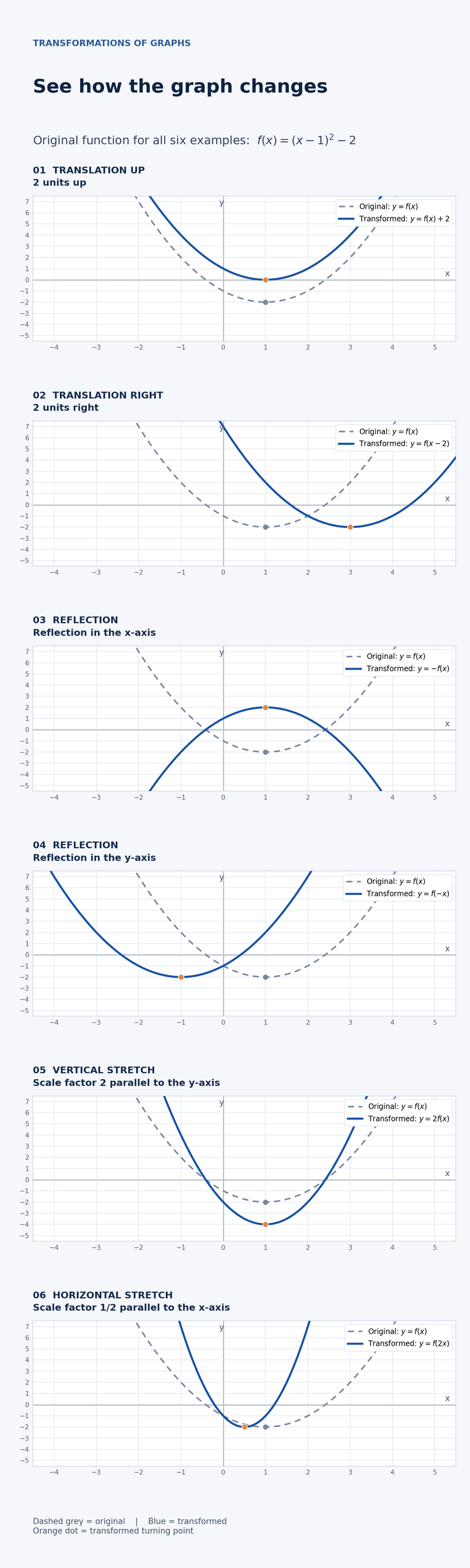
Start with the graph y = f(x). In the tables below, a > 0.
General rule · combined translations
For a > 0 and b > 0, y = f(x − a) + b means translate a units right and b units up.
Use the tables below to decide the directions when the signs change.
Translations
| New equation | Transformation |
|---|---|
| y = f(x) + a | Translate up by a units |
| y = f(x) − a | Translate down by a units |
| y = f(x − a) | Translate right by a units |
| y = f(x + a) | Translate left by a units |
Reflections and stretches
| New equation | Transformation |
|---|---|
| y = −f(x) | Reflection in the x-axis |
| y = f(−x) | Reflection in the y-axis |
| y = af(x) | Stretch parallel to the y-axis, scale factor a |
| y = f(ax) | Stretch parallel to the x-axis, scale factor |
WORKED EXAMPLE 7 · A combined translation
Describe the transformation from y = f(x) to y = f(x − 3) + 2.
Step 1: The change inside the brackets, x − 3, translates the graph 3 units to the right.
Step 2: The +2 outside the function translates it 2 units upwards.
So the combined translation is 3 units right and 2 units up.
Your turn · 4 questions
Try these questions before checking your answers.
Timer is unavailable in this view.
- Describe the transformation from y = f(x) to y = f(x − 4) − 2.
- Describe a sequence of transformations from y = f(x) to y = 2f(x + 3).
- Describe the transformation from y = f(x) to y = f(x + 2) − 3.
- Challenge: Describe a sequence of transformations from y = f(x) to y = −2f(x − 1). State the order.
Show answers and working
1. Translate 4 units to the right and 2 units down.
2. In f(x + 3), the +3 is inside the brackets, so translate 3 units left.
The 2 outside the function multiplies the output, so then stretch parallel to the y-axis by scale factor 2.
3. The +2 is inside the brackets, so translate 2 units left.
The −3 is outside the function, so translate 3 units down.
4. One valid order is:
1. The −1 inside the brackets translates the graph 1 unit right.
2. The factor 2 outside gives a stretch parallel to the y-axis with scale factor 2.
3. The negative sign outside gives a reflection in the x-axis.
Key idea: Changes outside f( ) affect the output. Changes inside f( ) affect the input in the opposite horizontal direction, with a reciprocal horizontal scale factor for stretches.
Past paper example · May/June 2026 · Paper 11 · Question 3
A stretch followed by a translation
The curve with equation y = x3 is stretched with scale factor 4 in the x-direction and then translated by the vector (5, −2).
Find the equation of the transformed curve. You do not need to simplify your answer. [3]
Show step-by-step solution
Step 1: stretch parallel to the x-axis. A scale factor of 4 means replace x with :
y =
Step 2: translate 5 units to the right. In the stretched equation, replace x by x − 5:
y = .
Step 3: translate 2 units down. Subtract 2 from the whole output:
y = − 2.
Check: the point (0, 0) moves to (5, −2), which satisfies the final equation.
Exam tip: use the reciprocal inside the function for a horizontal stretch, and apply transformations in the stated order.
Past paper example · May/June 2026 · Paper 12 · Question 2
Read transformations from two graphs
The solid graph is y = f(x) and the dashed graph is y = g(x).
The plotted points reproduce the graph in the supplied question. Solid: f; dashed: g.
(a) Describe fully a sequence of transformations that maps y = f(x) to y = g(x), stating the order. [5]
(b) Express g(x) in the form af(x + b) + c, where a, b and c are constants. [2]
Show step-by-step solution
Compare corresponding points. The corners (0, −10), (2, −4), (4, −6) and (6, −6) on f match (1, 0), (3, 3), (5, 2) and (7, 2) on g.
Horizontal change: Every x-coordinate increases by 1, so the graph moves 1 unit to the right.
Vertical scale: On f, the first two outputs change from −10 to −4: an increase of 6. On g, the matching outputs change from 0 to 3: an increase of 3. So the vertical scale factor is = .
Vertical shift: Halving −10 gives −5. To reach the matching output 0, add 5. Check another output: halving −4 gives −2, then adding 5 gives 3.
(a) One correct sequence is: stretch parallel to the y-axis by scale factor , then translate by the vector (1, 5).
(b) The horizontal shift right by 1 replaces x with x − 1. The vertical stretch multiplies the output by and the translation adds 5:
g(x) = f(x − 1) + 5.
Thus in the requested form, a = , b = −1 and c = 5.
Other equivalent transformation sequences are possible when their order is stated clearly.
Past Paper Examples
Find a worked example by paper and question. Try each question before opening the step-by-step solution.
May/June 2026 · Paper 11
Question 3 — Graph transformations
Question 9 — (a) Inverse · (b) Composite functions
May/June 2026 · Paper 12
Question 2 — Graph transformations
Question 10 — Quadratic function and inverse
May/June 2026 · Paper 15
Question 9 — Differentiation and inverse · Domain and range
Practice questions
Video lessons
Videos coming soon.